Where does Conductive Education belong in a school setting?
May 12, 2026
Where does Conductive Education belong in a school setting?
MBH currently delivers Conductive Education sessions in seven local schools, both specialist and mainstream. Here are some of the main ways conductive education helps children in school settings:
Developing independence
Conductive Education Specialists encourage children to complete tasks for themselves wherever possible. This can include:
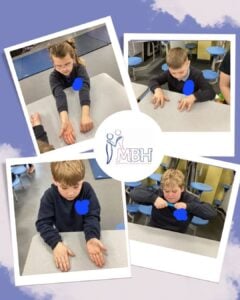
- Sitting independently – building core strength
- Moving between activities – transitions
- Dressing for PE – self-care
- Managing classroom equipment – fine manipulation
- Using cutlery at lunch – fine manipulation
- Organising themselves
The focus is on teaching how to solve movement and practical problems, not simply doing tasks for the child.
Supporting motor skills within learning
CE can be transferred into movement practice, such as:
- Writing activities
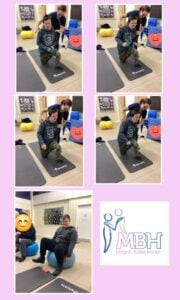
- Transitions around the classroom
- Group work
- Play
- PE
- Self-care routines
For example, a child may practise balance, posture, hand control and coordination, which is transferred to participating in literacy or maths activities.
Building confidence and motivation
Conductive Education Specialists will use:
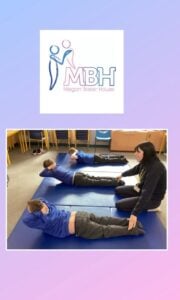
- Structured routines
- Rhythmic intention (spoken rhythm and verbal cues)
- Repetition with purpose
- Group encouragement
This can help children feel more successful and willing to attempt difficult tasks. Small achievements are reinforced consistently, which supports self-esteem and resilience.
Improving communication and social participation
Children are encouraged to:
- Communicate choices
- Work collaboratively
- Participate in group tasks
- Develop turn-taking and listening skills
- Develop speech through breathing tasks
Encouraging active learning
At MBH we aim to make children active participants rather than passive recipients of support. A child is encouraged to think through movements and strategies:
- “How can I get up from this chair?”
- “What do I need to hold?”
- “What comes next?”
This develops problem-solving and cognitive engagement as well as physical skills.
Consistency across the school day
A key strength of conductor-led practice in schools is consistency. Strategies for posture, mobility, communication and independence are used:
- In class
- During transitions
- At lunch
- In playground activities
- During personal care routines
This repeated practice in real contexts can support better carryover of skills.
Supporting inclusion
At MBH, we adapt activities so children can participate alongside peers rather than being separated for intervention. This can improve:
- Classroom inclusion
- Peer relationships
- Access to the curriculum
- Participation in wider school life
Benefits commonly reported by schools and families
Children at MBH have shown improvements in:
- Functional mobility – core strength
- Balance & co-ordination
- Attention and concentration
- Independence
- Self-confidence
- Communication
- Classroom participation/Social skills
- Emotional wellbeing
“MBH sessions have been a huge hit in school, and the children can’t wait for their next sessions. The impact of these weekly sessions has been seen in all areas of their school life; their core strength and posture have improved, impacting their movement around school and positioning in class. Their confidence has grown, and this is reflected in their academic progress. A prime example of the impact has been seen in swimming lessons where children are more confident, stronger and achieve. This improvement has also been noticed by the swimming coaches.”
For any more information regarding our school CE sessions for your child or a child within your school, contact Sue on
MBH are also happy to deliver a presentation or workshop about our services during a staff meeting if required 😊
In our next month’s blog, we will be asking why early intervention matters in Conductive Education.